
If you’re wondering how to find the best rhinoplasty surgeon, start here: Look for a surgeon with board certification, rhinoplasty-specific training, a strong understanding of facial harmony, and results that look natural on real patients. From there, the key is knowing how to evaluate those qualities to make an informed decision.


1. Make sure your surgeon is board certified in plastic surgery
Board certification is a must-have in your rhinoplasty search. It reflects rigorous training, testing, and a commitment to ethical surgical standards. Because rhinoplasty requires both technical precision and aesthetic judgment, you will want a surgeon with a strong surgical foundation before you look at anything else.
It is also important to look closely at which board certified the surgeon. Not every board carries the same standards or reflects training in a relevant specialty. The American Board of Plastic Surgery (ABPS), the only plastic surgery board recognized by the American Board of Medical Specialties (ABMS), is one of the most important credentials to look for when evaluating a plastic surgeon for rhinoplasty.
2. Look for rhinoplasty-specific experience
Not every plastic surgeon focuses heavily on nose surgery. As you’re comparing providers, consider whether the surgeon has made rhinoplasty a meaningful part of their practice. Ask how often they perform rhinoplasty, what types they perform, and whether they treat both cosmetic and functional concerns.
Look for a surgeon with hands-on experience across multiple types of rhinoplasty, not just routine cosmetic cases. Treating primary, functional, ethnic, and revision patients can reflect a broader command of nasal anatomy and a more tailored approach to surgical planning.
3. Pay attention to advanced training and professional involvement
Rhinoplasty is one of the most nuanced procedures in plastic surgery. Beyond board certification, it is worth paying attention to whether a surgeon has pursued advanced training that deepens their expertise in nasal surgery and facial anatomy. This may include craniofacial fellowship training, focused rhinoplasty education, or advanced study under surgeons known for their work in this area.
Professional involvement matters too. Membership in The Rhinoplasty Society is especially significant because it points to a deeper commitment to rhinoplasty as a specialized area of practice. In a procedure this nuanced, that kind of distinction can reflect ongoing education, focused expertise, and active engagement within a highly selective professional community.
4. Study before-and-after photos with a critical eye
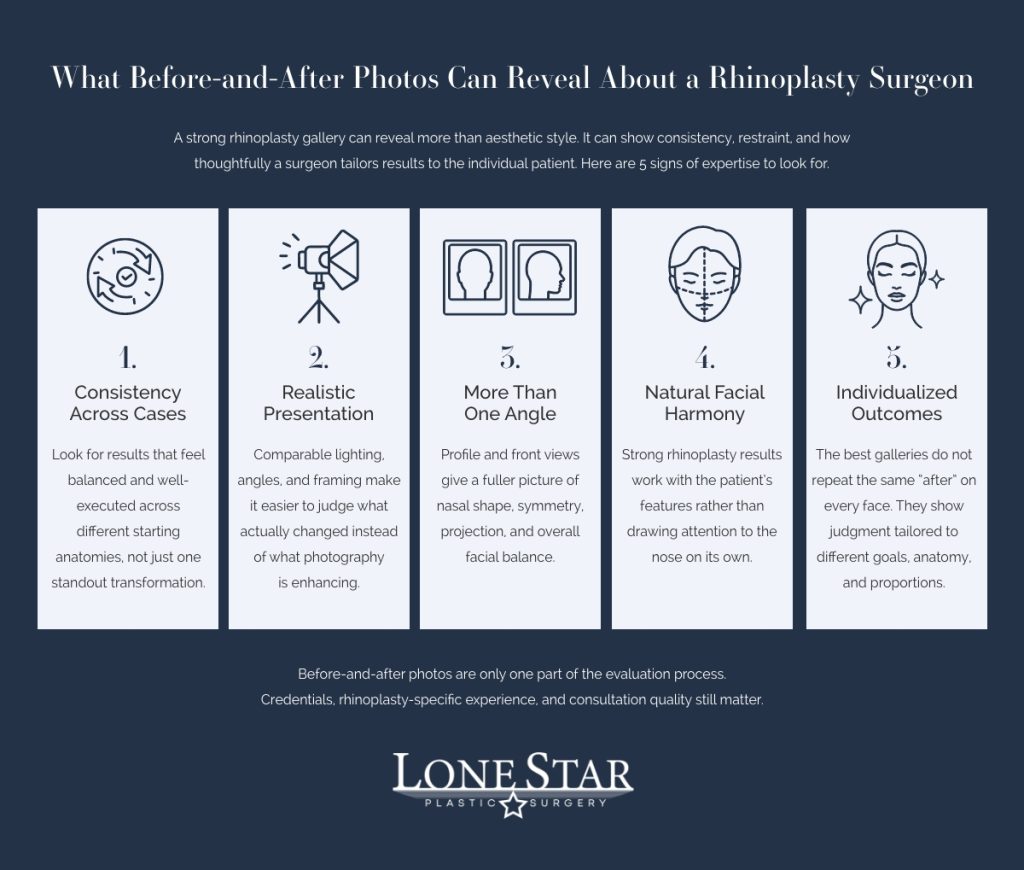
When you review a surgeon’s rhinoplasty before-and-after photos, look for consistency across different angles and different starting anatomies. A strong gallery should show noses that fit the face naturally rather than a copied “ideal” shape.
It is also helpful to look for patients whose concerns resemble your own, whether that is a dorsal hump, a bulbous tip, asymmetry, or issues related to prior injury. The goal is not to find your exact nose in someone else’s result, but to see whether the surgeon demonstrates thoughtful, balanced outcomes across a variety of cases.
5. Choose a surgeon who respects both form and function
A beautiful nose that does not breathe well is not a successful result. In many cases, cosmetic goals and functional improvement should be considered together.
Rhinoplasty may address concerns related to shape, proportion, structural changes after injury, congenital issues, or breathing problems, sometimes within the same surgical plan. The best rhinoplasty surgeons account for both the external appearance of the nose and its internal anatomy to create results that look natural and function well.
Primary vs. Revision Rhinoplasty: Why the Search for Expertise Changes
| Primary Rhinoplasty | Revision Rhinoplasty |
| The surgeon works from a more predictable anatomical starting point. | The surgeon may be working through scar tissue, structural changes, and less predictable anatomy. |
| Planning focuses on refining shape, proportion, and function. | Planning often requires correcting prior surgical changes while preserving or rebuilding support. |
| Expertise matters to ensure satisfactory results. | Revision cases have a smaller margin for error, calling for deeper experience and a higher level of surgical judgment. |
| Goals may be straightforward, even when highly customized. | Cosmetic and functional goals often require more complex tradeoffs and more careful planning. |
| Results rely on technique and healing. | Results rely even more on judgment, structural strategy, and experience with complex nasal surgery. |
6. Be especially careful if you are considering revision surgery
Revision rhinoplasty is often the most challenging facial procedure to perform because scar tissue, altered anatomy, and reduced cartilage support make surgical planning more complex. If you think you may need secondary surgery, your search should become even more selective.
Finding the best revision rhinoplasty surgeon means looking for someone with a strong understanding of structural support, healing patterns, and the limits of what can be changed safely and effectively. Revision nasal surgery is highly specialized, and not every surgeon chooses to take on these cases.
7. Use the consultation to judge honesty, not just credentials
The right surgeon should be transparent about risks, realistic outcomes, recovery, and whether you are a good candidate for rhinoplasty at all. During consultation, they should carefully evaluate your nose, your skin quality, facial bone structure, and how your nose relates to the rest of your features.
A thoughtful surgeon should educate you, not pressure you. Your rhinoplasty consultation should leave you with a clearer understanding of your options, what is realistically achievable, and whether the surgeon’s approach aligns with your goals.
Talk to a Rhinoplasty Specialist
The best rhinoplasty surgeon for you is not the person with the loudest online presence. It is the surgeon with the training, experience, judgment, and honesty to create a result that looks natural, functions well, and fits your unique face.
If you are doing your research now, take your time, ask good questions, and compare real results carefully. This due diligence now will pay important dividends later on. To get started with rhinoplasty at Lone Star Plastic Surgery, request a consultation or call our Frisco, Texas, office at (214) 937-4879.

Leave a Reply