Yes, rhinoplasty can fix a deviated septum when it is combined with septoplasty. For many patients, the same surgery that reshapes the nose can also correct the structural blockage affecting their breathing, addressing both concerns in a single surgery with a single recovery.
Whether you’ve been living with chronic congestion, struggling to breathe at night, or simply want a nose that looks and functions better, it’s worth understanding how these two goals intersect and what your options really are.
What Is a Deviated Septum, and What Causes It?
The nasal septum is the wall of cartilage and bone that runs down the center of your nose, dividing it into two airways. When that wall leans significantly to one side, it’s called a deviated septum. The deviation can be subtle or pronounced, but when it’s severe enough to narrow one or both nasal passages, it can make breathing noticeably harder.
A deviated septum has two common origins: Some people are born with the condition, and others develop a deviation after a nasal injury, such as a sports collision, a fall, or a blunt impact to the face. It’s also worth noting that many people with a deviated septum have no idea they have it until a surgeon examines the internal structure of their nose.
Symptoms like persistent congestion on one side, frequent sinus infections, snoring, or difficulty breathing through your nose can all point to a structural issue inside.


Rhinoplasty, Septoplasty, or Both? Understanding Your Options
Patients are often confused about the difference between these procedures and when each one is used. Here’s a straightforward breakdown:
- Septoplasty is a functional procedure focused entirely on correcting the internal position of the septum to improve airflow. It doesn’t change the external appearance of the nose.
- Rhinoplasty reshapes the external nose, addressing concerns like a dorsal hump, a wide tip, asymmetry, or overall proportions. It can be purely cosmetic or include functional components.
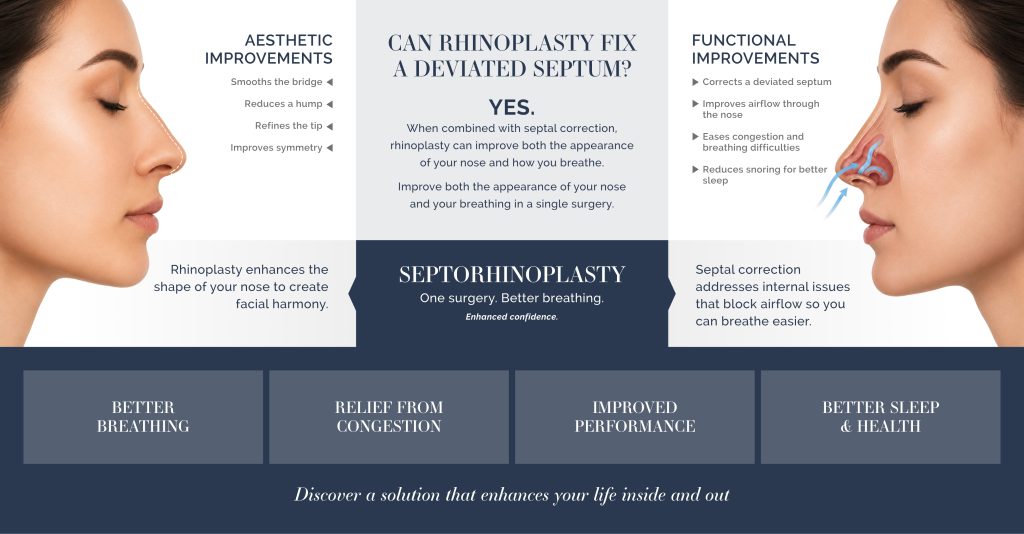
- Septorhinoplasty combines both. The surgeon corrects the deviated septum and refines the external appearance of the nose in the same procedure, so you undergo anesthesia only once and recover just once.
For patients with both cosmetic concerns and breathing problems, septorhinoplasty is often the most efficient and effective approach. Having the procedures separately means two surgeries, two recoveries, and more disruption to your daily life.
What Does Rhinoplasty for a Deviated Septum Involve?
When I evaluate a patient for rhinoplasty, I look at the nose as a whole structure, not just how it looks from the outside. A thorough assessment of the internal nasal anatomy is part of every consultation because what’s happening inside the nose affects both function and the long-term outcome of cosmetic work.
In many cases, patients come in focused on an aesthetic concern, and we discover a structural issue that has been affecting their breathing for years. In other cases, the conversation starts with breathing and ends with a plan that addresses the shape as well.
In a combined procedure, I reposition and straighten the deviated septum to open the airway while simultaneously making refinements to the external nose, such as smoothing a dorsal hump, refining the tip, or improving overall symmetry. I often prefer an open rhinoplasty technique because it gives me clear, direct access to the nose’s internal structures, allowing for precise, millimeter-level adjustments where they matter most.
Are You a Candidate for Rhinoplasty for a Deviated Septum?
You may be a good candidate for a septorhinoplasty if you’re in good overall health and relate to one or more of the following:
- You have a confirmed deviated septum and have trouble breathing through your nose, frequent congestion on one side, snoring, or disrupted sleep.
- You have cosmetic concerns about your nose and would like to address both the appearance and function at the same time.
- You’ve had previous nose surgery, and the breathing problem was not fully resolved.
- You are a nonsmoker or are prepared to stop smoking well before and after surgery
- You have realistic expectations for your outcomes
The best way to know whether you’re a candidate is a thorough in-person consultation. I use Crisalix® simulation technology to help patients visualize potential outcomes before making any decisions. This simulation supports a clearer conversation about what is possible and what is right for you specifically.
What To Expect From Your Results
Most patients notice an improvement in breathing relatively soon after surgery, once the initial swelling subsides. Cosmetic results develop more gradually. About 70% of the swelling resolves by the 3- to 4-week mark, and the nose continues to settle and refine over the following months. Final results are generally visible by 6 to 12 months after surgery.
Patients consistently tell me that the combination of improved breathing and feeling more confident about how they look makes the recovery well worth it.
My goal in every rhinoplasty, whether cosmetic, functional, or both, is to achieve lasting results that support healthy nasal function while maintaining or enhancing a natural, well-proportioned appearance.
Ready To Find Out What’s Possible?
If you’re dealing with breathing difficulties, are unhappy with the appearance of your nose, or both, a combined rhinoplasty and septoplasty may be the most practical and effective solution. I’d be glad to evaluate your concerns, discuss your goals, and help you understand exactly what a procedure could accomplish for you.
You can request a consultation using the online form or call us at (214) 937-4879 to schedule an appointment. Before your visit, feel free to browse some of our favorite rhinoplasty before-and-after transformations.

Leave a Reply